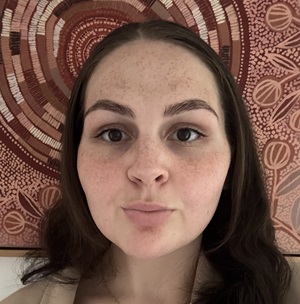
Kaleisha Cowan Roberts
Indigenous Health Scholarship
University of NSW, NSW.
Doctor of Medicine
Scholarship Awarded 2025
Sponsored by:
The Late Keith Henning OAM and Mina Howard
Student Profile
My name is Kaleisha Cowan Roberts, I am a proud Yuin and Bundjalung woman, who was fortunate enough to be born on Country in a small town called Nowra. I am a current 5th year medical student with less than 16 months left in my journey into medicine. I spent my whole childhood and teenage years living on Country, I was raised in Community and learnt the core values of my Cultural Identity from a very young age.
As a Saltwater woman, there is nothing more than the sounds of the ocean and the feeling of the sand to humble me and make me feel connected. My journey is still at the beginning of a long career but hopefully somewhere along that journey I will move into a speciality of Ophthalmology. However, for now, I am pushing towards my short term goals of finishing university, get an internship at a good hospital and taking opportunities to help mob out in Communities.
How will I contribute to improving Indigenous health as a qualified medical practitioner or health worker?
When my nan tagged me in a Facebook post about an Indigenous medical scholarship, I felt a deep sense of purpose. Growing up, I was often reminded to avoid reading comments on Indigenous news articles due to the harmful prejudice they contained. But this time, I read them. What I saw hurt—questions about our intelligence, our ability to practice medicine, and whether Aboriginal doctors could be trusted. Rather than discouraging me, these comments reinforced my resolve to pursue a career in medicine.
They highlighted the critical need for representation and why my role as an Indigenous doctor extends far beyond clinical knowledge. For over 60,000 years, our Ancestors have practiced holistic healing through a profound understanding of Land, Kinship, and Community. As an Aboriginal doctor, I will blend traditional health perspectives with Western medicine to offer culturally safe, patient-centred care. True healing requires more than diagnosing disease—it involves understanding lived experiences, historical trauma, and the systemic barriers impacting Indigenous health outcomes.
A key issue in Indigenous healthcare is accessibility. Many in our Communities struggle with a health system that doesn’t meet their needs. I aim to improve this system, whether through direct patient care, advocacy, or policy reform. I am committed to working in rural and remote communities, where chronic disease, mental health issues, and preventable illnesses are disproportionately high.
I also aspire to mentor the next generation of First Nations doctors. Through mentorship and community engagement, I will support others in overcoming the barriers I have faced and increase Indigenous representation in healthcare. My mission is to heal our People and transform pain into belonging.
Current Progressive Report
The last six months of 2025 have been some of the most demanding, formative, and ultimately rewarding months of my medical training. Academically, this period was defined by preparing for what felt like the worst exam I have encountered so far in medicine. The intensity of the content, the constant pressure to perform, and the emotional fatigue that accompanied revision often left me doubting my own capacity. Studying alongside 46 weeks of clinical placement out of a 52-week year pushed my limits in ways I had not previously experienced. Yet, completing one of the longest and most immersive years of my medical degree has given me a deep sense of resilience and quiet pride.
Despite the stress, this period was also marked by excitement and growth. Being consistently on placement allowed me to move beyond theory and truly inhabit the role of a future doctor. The long weeks fostered confidence, adaptability, and an appreciation for learning in real clinical environments, even when exhaustion set in. Finishing the year felt less like an ending and more like standing on the edge of something earned.
Alongside this, building strong relationships within AIDA has been a grounding and affirming experience. Being surrounded by Mob and allies who share values of respect, community, and cultural strength reminded me why I chose this path. These relationships offered support during challenging moments and reinforced the importance of Indigenous-led spaces in medicine.
A highlight of the last six months was commencing my first four weeks of elective in ophthalmology. This experience sparked curiosity and renewed motivation, allowing me to explore a specialty in a focused and meaningful way. It was a reminder that beyond exams and deadlines, medicine remains a field of fascination and purpose.
Finally, travelling to Brazil and Chile to contribute to the expansion of Indigenous Medicine programs at university level was profoundly impactful. Engaging with Indigenous communities and educators across borders broadened my perspective on global Indigenous health and reaffirmed the shared strength of Indigenous knowledge systems. This experience was both humbling and energising, closing the year with a deep sense of gratitude for the opportunities I have been trusted with and the doctor I am becoming.