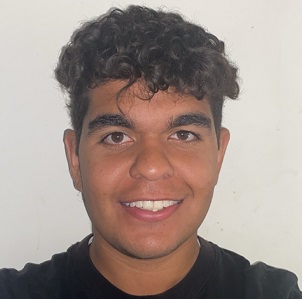
Kirby Hobbs
Indigenous Health Scholarship
University of Western Australia, WA
Bachelor of Biomedical Science
Scholarship Awarded 2024
Doctor of Medicine
Sponsored by:
Rotary Club of Matilda Bay & Rotary Club of Ascot
Student Profile
My name is Kirby, and I am a proud Walmatjarri man in my second year at the University of Western Australia. I am currently studying a Bachelor of Biomedical Science with an assured pathway into the Doctor of Medicine.
My motivation for choosing medicine comes from my desire to continue using my problem-solving skills and to fulfil my aptitude for helping people, both in the broader community and ultimately within my own community.
I am determined to utilise my future knowledge and skills, not only to treat individuals but also to advocate for equity in Aboriginal Peoples health by preventing and managing prevalent health issues.
I have always had a passion for helping children through tutoring and mentoring. This passion has carried on to my medical aspirations as I am going to specialise in Paediatrics after completing the Doctor of Medicine. This is not just a career choice but more of a personal commitment to making a positive difference to our youth in Aboriginal Communities.
How will I contribute to improving Indigenous health as a qualified medical practitioner or health worker?
When I become a paediatrician, I endeavour to work in rural, remote, and metropolitan areas. This will enable me to become a strong advocate to push for better health services and care for Aboriginal people in Australia. I feel that there is currently too large of a cultural disconnection between Doctors and Aboriginal people which has led to children and families being intimidated of visiting hospital. As a future paediatrician, I will provide this genuine connection with Aboriginal people and make our children feel comfortable and taken care of in Hospitals.
Right now, the gap is still existent between Aboriginal and Non-Aboriginal People, and it will be my goal to bridge this gap by advocating for a positive, culturally safe environment which will allow our people to have equitable outcomes for their health. We need people in positions who will advocate for Indigenous health. We need more Aboriginal Doctors to help bridge this gap that Doctors are now endeavouring and pushing to close, and it would mean the of utmost importance to humbly be able to contribute to this cause.
Through my work as a paediatrician, I aim to advocate for improved health services and care, particularly in rural and remote areas where disparities are most pronounced.
My motivation and desire to become a doctor is deeply rooted in my own family’s experiences with health issues, notably cardiovascular diseases, and kidney problems. Witnessing these struggles firsthand has fuelled my determination to pursue a career in medicine by preventing.
Current Progressive Report
For the first half of the six months, we were still on campus doing our Rheumatology and Neurology blocks. I found this to be one of the hardest parts of university so far. I really struggled to conceptualise some of the harder topics, especially the anatomy involved in both Neurology and Rheumatology. There was a lot of information to learn in a short period of time, and at times it felt quite overwhelming. We then had a week of preparation before starting placement, which made everything feel a lot more real.
I was very excited but also nervous to start placement. It was a completely new environment and a very different way of learning compared with lectures and tutorials. I have definitely found that I enjoy being on placement much more than being on campus. I find it much easier to learn when I can see a patient, talk to them and actually connect what I am learning to a real person.
I started Internal Medicine on the Acute Medical Unit. AMU was quite tough to start with because the teams could be different each day and I initially found it hard to understand how the ward worked and where I fitted in as a medical student.
For the second half of Internal Medicine, I moved to Gastroenterology. I started on the lumen team, which mainly looked after patients with gastrointestinal problems that were not liver related. I really enjoyed Gastro and was able to get much more involved on the ward. I also had the chance to watch colonoscopies, practise some procedural skills and spend a lot of time talking to patients. One of the best parts was being able to follow patients throughout their admission and see how they progressed rather than only meeting them for a couple of days. We also had weekly Gastroenterology teaching about different conditions and procedures. A lot of it was aimed above medical student level, but I still found it really interesting and enjoyed being exposed to that extra level of knowledge.
I then finished my Geriatrics placement. Going into it, I thought Geriatrics was probably going to be my least favourite placement, but my mind changed very quickly. I was mainly involved in rehabilitation medicine and really enjoyed being able to follow the same patients over a number of weeks and actually see them improve. It also showed me how important the whole multidisciplinary team is, including physiotherapy, occupational therapy, social work, nursing and medicine. Most days I probably stayed longer than I needed to, but the time went very quickly because I was enjoying it. It is definitely an area I could see myself working in in the future, which I did not expect before starting.
Outside of medicine, hockey is still a big part of my life. I am currently coaching a Year 11/12 team who are looking likely to make finals, as well as playing Division 1 and Division 2 in the Perth competition, with I hopefully play finals in both. Hockey has been a good way for me to switch off from medicine and have something outside placement to focus on.
I have not been able to tutor at Follow the Dream as much this year because placement does not have a set timetable, which has made it difficult to commit to regular tutoring sessions. I am hoping on my next placement, I will find a set time to be able to get back into it.
Overall, the last six months have probably been the most enjoyable part of medicine for me so far. Starting placement has made me much more excited about the course and has helped me realise that I learn much better through seeing and doing things rather than sitting in lectures.
I am very grateful to Australian Rotary Health for their continued support throughout my studies. Their support has helped me continue to focus on medicine while also staying involved in the community, which is important to me.