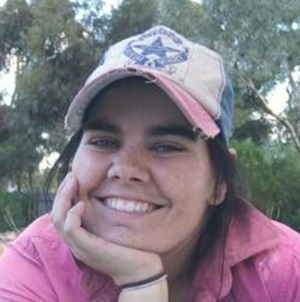
Lesley McKenzie
Indigenous Health Scholarship
University of Sydney, NSW.
Doctor of Medicine
Scholarship Awarded 2025
Sponsored by:
Joe Scorer/Rotary Club of Batemans Bay
Student Profile
My people are Galari clan, on Wiradjuri Country. I grew up in Condobolin, NSW, and my father, a white stockman/shearer has a small hobby farm on the Garli Bila (the Lachlan River), my mother is a Tafe teacher of Aboriginal Studies. I have two brothers; I am the middle child and grew up very typically for any other country kid, playing netball, pony club, and cricket. It is through growing up in a small rural town that I witnessed firsthand the unjust realities of what it is like to grow up in the bush.
Educational and health outcomes are statistically lower in rural and remote communities and as an Indigenous person, it is statistically more likely for me to go to gaol than it is for me to go to university. Furthermore, these early experiences of living in a rural, mostly Indigenous populated community shaped my understanding of healthcare inequities and ignited my passion to close the gap.
Whilst I did begin my career in education, my personal connection and ongoing experiences have driven me to begin a career in medicine to improve Indigenous health outcomes. .
How will I contribute to improving Indigenous health as a qualified medical practitioner or health worker?
As a qualified health practitioner improving Indigenous health care would be a top priority of mine. I believe strongly about strategies that would be culturally appropriate and inclusive to Indigenous communities and some of these would include:
- Preventative and regular health care screening.
- Advocating for more services and multidisciplinary services that can address specific needs of individual communities, specifically in rural and remote communities.
- Supporting Indigenous workers within the health care system, as racism is still quite common in the workplace.
- Collaborating with community members and listening to stories. Including Indigenous community members in decision making also assists health autonomy.
- Education about preventative care for common illnesses to improve health literacy, this would also assist in eliminating barriers of ‘shame’ about certain illnesses. Outreach programs are a fantastic way to do this.
It is important for medical practitioners to have clear, respectful and culturally sensitive communication within Indigenous communities, and since doctors are always given so much trust, it is paramount that that trust is always held onto and protected, especially when considering the history of this country. I think research and evidence-based practice, pushing for policy change as well as supporting and listening to traditional healing practices is a fantastic way to advocate for Indigenous health outcomes to change.
Current Progressive Report
Looking back on the first six months of medical school, I can confidently say this has been one of the most challenging, rewarding and transformative years yet. Repeating year 1 was a very daunting thought in January because I knew I would have to integrate; it also meant stepping into an entirely new cohort, navigating unfamiliar personalities, and finding my place within a completely different dynamic than last year.
If I am being honest, I underestimated how anxious I would feel starting again. Repeating first year meant returning to university while everyone around me was meeting each other for the first time, and I was hyper aware of that assumptions others would make about me. Over time, however, I have realised that belonging is less about trying to fit into every group and more about finding the people who genuinely value and support you. As the semester progressed, those anxieties slowly eased, and I became much more comfortable simply being myself; as Dr Seuss says, ‘those that mind don’t matter, and those that matter don’t mind”.
I truly do not believe this degree is something that anyone can complete alone. I have learnt to invest my energy into the people who encourage me, celebrate my successes and support me through the difficult weeks, and I them. I have intentionally created a safe environment in which I can quietly flourish, and I have realised that this is enough. I am a strong believer that to be in a good village, you must be a good villager.
Academically, I am pleased with my progress. I successfully passed all my examinations, except for my second KAT, which I narrowly missed by a single mark. While that result was disappointing, the circumstances surrounding that assessment were particularly challenging.
Reflecting on that experience has reiterated to me that life does not stop simply because I have exams. As difficult as that week was, it reinforced the importance of learning how to compartmentalise, prioritise and continue functioning during challenging circumstances. I believe this is an important skill not only for medical school but also for becoming a compassionate and capable doctor. It is something I continue to consciously work on.
Throughout the year, I have regularly returned to the simple goal I set for myself at the beginning of medical school: get from Year 1 to Year 2. While it sounds straightforward, reminding myself of that goal has become an important stabiliser whenever I feel overwhelmed by everyday life. Rather than becoming consumed by individual setbacks, I remind myself that progress is measured over the entire year, not a single week or assessment.
Having this perspective has also encouraged me to build a routine that supports both my learning and my well-being. Most mornings begin early with a gym session before independent study and then a full day at university. That structure has become incredibly valuable, providing consistency even when other aspects of life feel unpredictable, and now I also don’t need help opening jars.
Financially, I have been fortunate to secure flexible tutoring work throughout the semester. This job allow me to earn some income while still prioritising my studies, and as examinations approach, I can significantly reduce my working hours or stop working altogether. I am incredibly grateful to have employers who understand the demands of medical school and provide that flexibility.
Outside of study, I have worked hard to maintain balance by combining social time with healthy habits. Study groups remain both productive and reassuring, usually involving a healthy amount of communal complaining about our very privileged first-world problems before we return to work. By the middle of semester there is almost always a girls’ night involving face masks, updates on the best coffee beans, or lengthy discussions about which vacuum cleaner offers the best value for money. Those conversations always make me laugh because they remind me that my friends and I are quietly settling into adulthood together.
Receiving this scholarship continues to make an enormous difference to my journey. Beyond the financial support, it serves as a reminder that others believe in my potential and have invested in my future. That encouragement has helped me persevere through some very difficult moments this year, and I remain deeply grateful for the opportunities this scholarship has provided.
Although the first six months have certainly not been easy, they have strengthened my resilience, clarified my priorities and reinforced exactly why I chose medicine. I know there will continue to be challenges ahead, but I also know that I have developed the support systems, perspective and determination needed to continue moving forward. I look forward to the second half of the year with optimism and with a continued commitment to growing into the kind of doctor I hope to become.