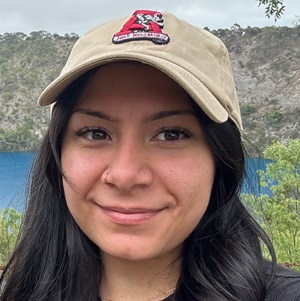
Louise Tusche-Pratt
Indigenous Health Scholarship
Monash University, Vic.
Bachelor of Medical Science and Doctor of Medicine
Scholarship Awarded 2025
Sponsored by:
Rotary Club of Boxhill Burwood
Student Profile
My name is Louise and I’m a proud Arrernte woman in my final year of the Bachelor of Medical Science and Doctor of Medicine degree at Monash University. I’m passionate about Indigenous health and addressing the ongoing health inequities faced by our communities.
During my studies, I have been actively involved in Indigenous health advocacy through leadership roles within Monash University’s Indigenous and rural health committee, WILDFIRE, first as the Indigenous Representative for two years, before becoming the Indigenous Chair for another two years. In these roles, I developed and led projects aimed at informing medical students about Indigenous health issues, encouraging greater awareness and cultural sensitivity. I’ve also enjoyed mentoring Indigenous students, helping to foster a supportive environment and provide academic guidance for fellow Indigenous students pursuing medicine.
I aspire to become a doctor working in psychiatry with the goal of improving health outcomes for Indigenous Australians. This scholarship will allow me to focus on my studies while continuing to contribute to the Indigenous health space through advocacy and community engagement.
I’m incredibly grateful for the support of Australian Rotary Health in helping me pursue my dream of becoming a doctor and giving back to my community.
How will I contribute to improving Indigenous health as a qualified medical practitioner or health worker?
I recognise the deep-rooted mistrust that many Aboriginal and Torres Strait Islander people feel toward the healthcare system due to historical injustices and ongoing discrimination. As a doctor, I will prioritise building strong, respectful relationships with my Aboriginal and Torris Strait Islander patients, ensuring they feel heard, valued and respected. This means advocating for culturally safe practices, incorporating Indigenous perspectives into patient care, and collaborating with Indigenous healthcare workers to deliver holistic, community-led solutions.
I also aim to contribute to policy discussions and initiatives that address systemic barriers to healthcare access. Whether through research, clinical practice, or community outreach, I am committed to reducing health disparities and improving health outcomes for Aboriginal and Torres Strait Islander peoples.
Current Progressive Report
I wanted to take a moment to share how things have been going with my studies and life more broadly, especially as I near the end of my medical degree. It has been a big year so far, filled with challenges, growth, and some emotional ups and downs. I’m incredibly grateful for your support, which has made such a difference to my ability to focus on learning and caring for my wellbeing during such a demanding time.
This year feels quite different from previous years. Many people say that fourth year is the last “real” academic year, and that fifth year is more like working as a junior doctor, just without the pay. I can really relate to that. I’m seeing patients on my own, presenting cases to more senior doctors, and doing a lot of the day-to-day admin like discharge summaries and referrals. I love the independence and responsibility that comes with it, even though it can be overwhelming at times. My days are full of real clinical work rather than lectures, and although I still attend a few teaching sessions each month, most of my learning now happens on the wards.
The first rotation of the year was my SIP (research) placement, which was conducted entirely online. While I gained a new appreciation for the work that goes into medical research, I realised that it is not something I personally want to pursue long-term. After that, I moved into psychiatry, which I also really enjoyed during fourth year. It stands out to me because it involves so much listening and understanding of a patient’s story. Unlike many areas of medicine where treatment is fairly standardised, psychiatric treatments must be carefully tailored to the individual’s circumstances, preferences, and lifestyle. It feels human and personal in a way that other specialties sometimes do not.
My next rotation was general medicine. Honestly, I felt nervous about it at first. It had been a while since I had practised some of the core clinical and procedural skills and I felt out of touch with the third year content that general medicine relies heavily on. But I was surprised by how quickly things came back to me. It ended up being an incredibly useful rotation, both for refreshing my clinical knowledge and for improving my paperwork and administrative skills, which are such a big part of being a junior doctor.
Currently, I’m finishing up my emergency medicine rotation at Casey Hospital. I’ve been doing evening shifts from 2pm to 11pm four days a week, hoping to see more complex and interesting cases during those hours – and that’s definitely been the case. I really enjoy the fast-paced environment of the ED, and the constant variety keeps me engaged each day. It’s the kind of setting that reminds me why I chose medicine in the first place. That said, I had not anticipated how exhausting this shift pattern would be. Including travel time, my days stretch to nearly twelve hours and I often only manage to sit down for about 30 minutes during the whole shift. My sleep schedule is completely off, and I have found myself dealing with a level of mental and physical fatigue that I’ve never experienced before. Still, it has been one of the most rewarding rotations, and it’s made me seriously consider emergency medicine as a future specialty.
In terms of exams, we haven’t had any major ones yet, but I do have my first two next week. One is APEx, which assesses our clinical examination skills, and the other is a life support and emergency management exam. With the intensity of the ED rotation and the toll of demanding shifts, I have found it really difficult to stay on top of study while also looking after myself. On my days off, I barely leave the house except to run essential errands because of the exhaustion. I genuinely don’t know how I had managed everything if I also had to work a part-time job to support myself financially. Having some extra time this week to focus purely on study has been such a gift, and I truly can’t thank you enough.
Outside of medicine, I’ve found a lot of joy in reading. It’s my way of winding down and disconnecting from the constant demands of clinical life. I don’t really watch TV or spend time on social media, so instead I’ve been working towards my goal of reading 150 books this year. I’m already up to 90, thanks to a mix of physical books and audiobooks during chores or travelling to/from the hospital. It’s something small that keeps me grounded and gives me a mental break from everything else.
I recently received my job offer for next year, and I’ll be heading home to Darwin. I am overjoyed. Not only will I be there to support my mum and nanna, but I’ll also be back with my family and friends, and I’ll be starting my career in the community I care so deeply about. I know there are a lot of challenges in the healthcare system back home, especially for Aboriginal and Torres Strait Islander peoples, and while I can’t fix everything, I hope I can be someone that patients trust and feel safe with. That, to me, would mean everything.
Thank you again for supporting me through this journey. It’s been a hard year in many ways, but also one full of learning and personal growth. Your generosity has made a real difference to me, and I look forward to sharing more milestones as I get closer to graduation.