Vincent Batchelor
Rural Medical Scholarship 2025
Australian National University, NSW
Bega Clinical School
Scholarship Awarded 2025
Sponsored by:
PDG Joe Scorer Rural Medical Scholarship
How would the Australian Rotary Rural Health Scholarship help with my studies at the Rural Clinical School?
Years of university in metropolitan Australia provided a high-quality education and lifelong friendships; yet, why did I continue feeling that something was missing? Upon reflection, I realised that this void arose from my unique childhood experiences spent in rural locations. Born to adventure-bound parents of Australian and Malaysian-Indian origin, my sisters and I travelled widely, living in Western Australia as well as far-flung towns in Spain, Saudi Arabia, Malaysia and the UK. It’s clear that deep-rooted community values were instilled deep within me. I recall the simplicity of thriving in small towns where I felt I knew everyone and listened to all their stories of daily life. Where it was fine to leave the doors unlocked or spontaneously cycle to a neighbour’s home and be invited to share a family meal; where I cannot recall feeling alone in spite of there being less bustle than the cities. My passion for rural life was ignited long before I discovered medicine. Consequently, I jumped at the opportunity to chase this passion with a long-term placement in Bega.
Growing up, my family and I always went out of our way to engage with community in the small towns we travelled to. I have fond memories of participating in regular community arts productions in local theatres. Personally, I made a point to join local societies like the Boy Scouts, food kitchens, and volunteer for overseas trips to natural disaster or civil strife zones. This pattern continued as an adult in Melbourne and Canberra during my University studies. An illustrative experience is my becoming President of the ANU Basketball Club. In that role I coached several teams, ran competitions, and encouraged people to make new friends who may not have otherwise connected. I like to think my upbringing inspired this desire to serve and I aspire to continue so in Bega.
Moving to Bega will come with challenges. I will leave my job in Canberra, relying solely on Youth Allowance to support myself through this intense phase. Notably, fulltime placements in hospitals will limit time for paid work, further pressuring finances. A scholarship would relieve this burden. Additionally, placements are more self-directed, intense, and complex than pre-clinical studies, with many learning opportunities only available to those with the time and resources to pursue them. If financial concerns arise, it’s possible I will miss these opportunities in the Bega Hospital and beyond.
Next year, I plan to continue my passion for volunteering with local charities, like Sapphire Community Pantry, which I was volunteered in during our recent visit, the local Park Run and others I’m sure to encounter. I greatly admire the spirit of community and fellowship I’ve already noticed in Bega. I am eager to participate in Rotary events and initiatives, seeing them as an opportunity to give back, reconnect with the values of my childhood, and integrate more deeply into the Bega community.
Current Progressive Report
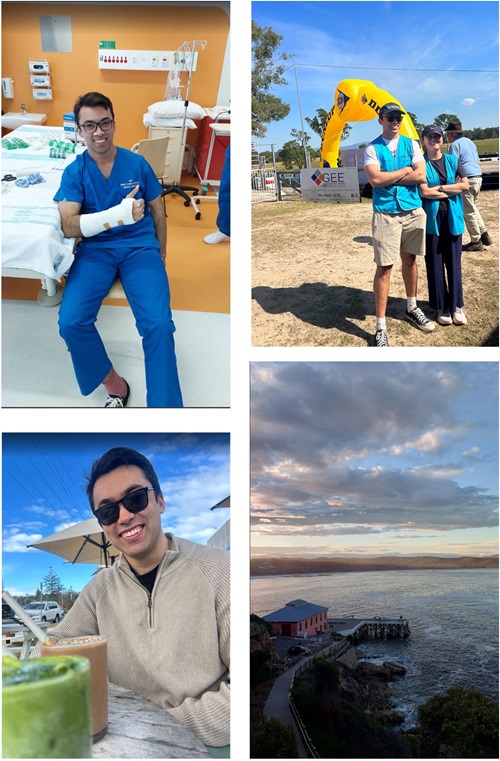
My year in Bega was a year of many firsts. It was the first year I had properly moved to live in a rural location in Australia. I had the benefit of moving with my friends and peers into a lovely place not too far from the Southeast Regional Hospital in Bega. It was great to have their company, but what surprised me was the friendliness and hospitality of those already living in town. In the hospital, I learned so much from clinicians, nurses, and allied health alike who were keen to bestow on me a love for country medicine. On reflection and comparison with my city peers, it’s fair to say that we have it better in the country. An experience that especially comes to mind is the hospitality in which our local ANU administrator, opened her home to us after our exams for a lovely dinner to celebrate completion of a tough exam. What ended happening, however, was that we all recounted the stories of our great time in Bega and reflected on what a return to the city might entail. I, like many of my peers, have already made plans to return to the Bega valley for further training.
Out in the community, I made many friends in the local vibrant basketball competition. While my team didn’t get up in the finals (finishing with second place), the season was a fun one of making friends from across the Bega community. The scholarship also allowed me time to volunteer and make friends at the local food pantry, Sapphire community pantry. It is an excellent place with great coffee, and an even lovelier team. Furthermore, I got to put my acting dreams to the test during the emergency services drill day where I was a casualty that was at a simulated car crash performed to much fanfare outside the hospital.
My Rotary Bursary peer, Anishka, and I also had the opportunity to present to the local chapter of the Rotary about all the amazing experiences we had in the clinical practices set up all along the valley and reaffirm just how important this scholarship was for making this move a viable option for us. Without this scholarship, I truly believe this opportunity would not have been available to me. Without this scholarship, I would not have been able to immerse myself into more community activities than I can list here in this short final reflection.
Overall, I recommend that anyone considering country medicine to come out and try it for yourself. I am deeply grateful to the Rotary Club for providing me with the financial means to be able to take this opportunity without having to worry so deeply about the financial implications of that extensive unpaid placements puts on medical students. In fact, the scholarship allowed me to take up opportunities that I might not have otherwise pursued. In sum, go rural!